
Office Containers: A Brief History
The invention of the modern shipping container by Malcolm McLean in 1950 revolutionized global logistics. Initially, the use of the container was geared towards making the movement of goods more convenient in the shipping sector. Due to their durability, they were soon put to use by the military as makeshift shelters during the 1960s, providing instant accommodation in case of emergencies in various locations across the globe. These humble beginnings of office containers have come a long way since then, showing their versatility even before gaining popularity, and are now being utilized in practical applications, such as employee rest areas or at temporary construction sites. Office containers became plentiful within the 21st century.

Peter DeMaria’s 2006 Redondo Beach House marked the US debut of container architecture, sparking a global shipping container construction boom that continues today. Despite widespread adoption of office containers, most people overlook their key role in sustainable building through material reuse and eco-efficiency.
Benefits of Office Containers’ Modular Design
The modular concept of office containers gives them an edge because the standardized size, in terms of width and height dimensions – usually 8 feet wide by 8.5 to 9.5 feet high, for a 20-foot office container – makes the office containers easy to stack together within large structures.
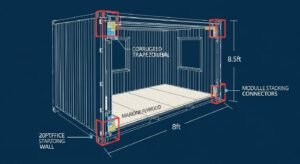
With improved manufacturing and assembling through modularity, are more flexible, minimize variability of components, and keep costs down. These have great benefits such as improving the quality of products, simplifying design, making full use of labor and material resources, cutting construction times from months to just days, and offering the best value of money to firms operating in dynamic environments, such as the UAE. The materials used to manufacture office containers include steel. In addition, they are capable of surviving both extremely hot and cold climates.
Office Containers as Sustainable Workspaces
The use of office containers is increasingly being utilized as innovative work environments, which extend their use beyond just delivery and storage. The interior designers are taking advantage of their capabilities by coming up with economical and efficient options compared to traditional administrative systems. Sustainable design strategies are implemented within modular office containers through the use of exterior shading, natural ventilation, and advanced insulation systems both internally and externally for thermal efficiency. These developments in office containers occur during worldwide trends towards green and environmentally friendly architectural designs.
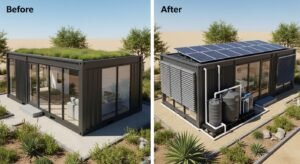
Office containers serve perfectly well as reusable construction components due to their definite size, high levels of strength, durability, and weather resistance appropriate for various purposes. The office container enables the creation of alternative places of work in the fast-paced world of today through techniques that are quick and economical, as opposed to the complicated designs associated with buildings that take long to construct.
Key Advanced Features
Office containers deliver unbeatable advanced features that slash costs and boost sustainability:
- Solar Power Independence: Photovoltaic panels generate enough electricity to power heating, cooling, and lighting—eliminating grid dependency and cutting energy bills by 60-80%.
- Lightning-Fast Deployment: Prefabrication + solar integration cuts construction time 50-70% vs traditional builds with zero-waste off-site assembly.
- Ultra-Low Maintenance: Corrosion-resistant coatings guarantee decades of service with minimal upkeep—30% lower costs than conventional offices.
- Smart Water Systems: Rainwater harvesting tanks collect roof runoff for irrigation/flushing, ensuring water independence in arid UAE climates.
Economic Advantages of Office Containers
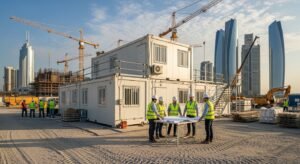
The economic advantages of using modular office containers are obvious. While brick-and-mortar offices require double the initial investment and operating costs, a standard 20-foot office container will cost about AED 15,000 to AED 25,000 with a floor area of 160 square feet. Bigger units such as 40-foot modular office containers will comfortably accommodate up to 10-20 personnel at a time and can even be stacked two floors high. The construction industry in the United Arab Emirates is booming, with projects worth more than AED 100 billion underway at the moment. The use of portable office containers allows for on-site management of the projects within controlled climatic conditions and high connectivity. This appeal becomes clearer with the inclusion of sustainable practices that involve the reuse of one shipping container that avoids up to four tons of steel going to waste in landfill sites and the use of modular container office solutions that ensures 90% less construction waste than site-built offices.
Future of Office Containers and Smart Design
The modular container office solutions can offer unrivalled flexibility to businesses that plan to grow in the future. Start off by getting one portable office container for your core team, but connect several office containers modules using waterproof corridors, thus giving rise to a campus-like setup that can support up to 50 employees. Such flexibility allows you to adopt a hybrid working system where the employees can work from the office containers, the sites, and their homes, fostering collaboration without signing any binding lease agreements. The premium office containers UAE by BAF and other such companies are well-known in the UAE. The intelligent design tackles challenges such as space optimization directly. To counteract any feeling of being cramped, designers use furniture that can be folded, storage that can be mounted on walls, and partitions that have multiple purposes, employing mirrors, light color schemes, and vertical gardens to create an appearance of spaciousness. Passive solar designs position the unit to maximize sunlight in the morning and minimize sunlight in the afternoon, and improvements to ventilation through ceiling fans and cross-ventilation reduce the need for air conditioning. These features make instant container office deployment possible for urgent needs. In summary, these containers represent a shift in paradigm within the industry where there is less focus on resource-consuming ventures and more emphasis on sustainable reusable resources. They represent sustainability, quickness, and financial savings, offering instant deployment.