
Revolutionizing UAE National Housing: Prefab Innovation as the Future Solution
Public housing for UAE nationals has long been a cornerstone of the nation’s social and economic development strategy. Over the past four decades, government initiatives have delivered millions of housing units, yet persistent challenges remain: rising demand, urban density pressures, environmental sustainability concerns, and the need for homes that truly reflect Emirati family values and modern lifestyles. In this context, Prefabricated House solutions are emerging as a promising approach, offering faster construction, cost efficiency, and sustainable design while aligning with the evolving housing needs of UAE citizens. Traditional construction methods struggle to keep pace with Dubai’s rapid urbanization and the UAE’s ambitious Vision 2030 goals. This comprehensive study proposes a transformative approach—leveraging prefabricated (prefab) innovation through panelized homes, computational design, and hybrid manufacturing—to create affordable, adaptable, and culturally resonant housing solutions. By integrating cutting-edge prefab homes UAE for sale with local manufacturing capabilities, this strategy positions Dubai as a global leader in sustainable urban living.
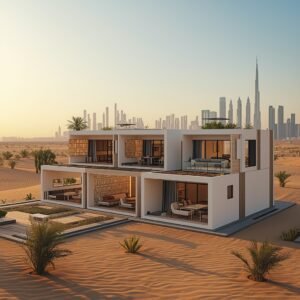
Imagine a sleek, multi-level panelized home rising efficiently on a Dubai plot—much like Stillwater Dwellings’ modern designs in Lake Whatcom, United States, but optimized for the UAE’s desert climate. These prefabricated homes Dubai aren’t just structures; they’re dynamic spaces that evolve with residents’ needs, blending tradition with technology. This paper explores the “why,” “how,” and “what’s next” for revolutionizing national housing.
 Persistent Challenges in UAE Public Housing
UAE’s public housing programs, managed by entities like the Ministry of Housing and Urban Planning, have successfully provided over 1.5 million units since the 1980s. However, several gaps hinder long-term viability:
Family Dynamics Mismatch: Traditional layouts often fail to accommodate extended Emirati families, where multi-generational living requires flexible majlis (guest reception areas), private family zones, and outdoor courtyards respecting Islamic privacy norms.
Socioeconomic Pressures: With land scarcity in Dubai and Abu Dhabi, costs have escalated 30-50% in the last decade, pricing out middle-income nationals despite subsidies.
Environmental Demands: UAE’s extreme heat (up to 50°C summers) demands superior insulation, shading, and energy efficiency. Conventional concrete-block construction consumes vast energy for cooling—up to 70% of a building’s lifecycle emissions.
Construction Delays: Labor shortages and supply chain issues extend timelines by 6-12 months, exacerbating housing shortages amid population growth projected at 2.5% annually.
These issues underscore the need for innovation. Prefabricated homes Dubai offer a compelling alternative: factory-controlled quality, 40-60% faster builds, and 20-30% cost savings.
Core Pillars of the Proposed Prefab Strategy
The strategy hinges on three interconnected pillars, forming a holistic framework for the best prefabricated homes in Dubai 2026.
- Design Flexibility for Cult
 ural Personalization
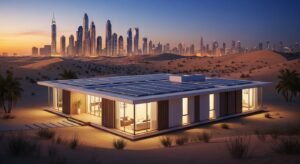
Prefab doesn’t mean cookie-cutter. This pillar emphasizes modular panelized systems where components—walls, floors, roofs—are pre-engineered for on-site reconfiguration. Residents can customize:
- Spatial Adaptability: Sliding partitions convert open-plan living areas into private bedrooms or expand the majlis for Ramadan gatherings.
- Cultural Integration: Incorporate mashrabiya screens for privacy and ventilation, wind towers (barjeels) reimagined in prefab panels, and south-facing courtyards for natural cooling.
- Scalability: From 200 sqm starter homes to 500 sqm luxury villas, all using interchangeable panels.
Real-world precedent: Singapore’s HDB prefab flats allow 80% customization, boosting resident satisfaction by 25%.
- Computational Façade Optimization
UAE’s climate demands smart envelopes. Using AI-driven tools like Grasshopper and Ladybug, facades are optimized pixel-by-pixel:
- Shading Analysis: Algorithmically generated louvers reduce solar gain by 40%, cutting AC use by 30%.
- Material Selection: Integrate aerogel insulation (R-20 per inch) with phase-change materials that absorb daytime heat.
- Responsive Elements: Kinetic panels adjust via sensors, mimicking traditional badgirs while achieving LEED Platinum ratings.
A simulated Dubai tower with this system shows 35% energy savings over code-compliant builds.
- Hybrid Prefab Manufacturing
Merge proven precast concrete (abundant in UAE) with emerging 3D printing:
- Precast Panels: Locally sourced from Dubai factories, providing fire resistance and seismic durability.
- 3D-Printed Accents: Custom curves for Islamic motifs or curved walls, printed on-site in 24 hours.
- Factory Efficiency: 90% off-site assembly reduces site waste by 70% and labor by 50%.
This hybrid scales nationally: Dubai factories could produce 50,000 units/year, enough for 10% of annual demand.
Detailed Plan for Design and Delivery
This isn’t a replacement for existing programs but a complementary track targeting 20% of new allocations. Implementation unfolds in phases:
- Research & Prototyping (2026-2027): Partner with Khalifa University and Dubai Municipality for pilot projects. Build 10 test homes in Al Warsan, testing adaptability via resident feedback loops.
- Policy Integration (2027-2028): Amend housing laws to incentivize prefab via 15% subsidies and fast-track permits (30 days vs. 6 months).
- Scaling Production (2028+): Establish five hybrid factories in industrial zones like Jebel Ali, creating 5,000 jobs.
Key motivators include adaptability planning, façade optimization software integration, and prefab deployment protocols. Metrics for success: 50% build time reduction, 25% cost drop, 90% resident approval.
Navigating the UAE Prefab Market: Where to Find Options
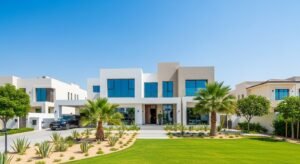
UAE’s prefab ecosystem is maturing, with local and international players. For prefab homes UAE for sale:
Online Marketplaces and Classifieds
- com: Search “prefab homes Dubai” or “modular houses UAE.” Listings feature 2-4 bedroom units from AED 500K, with photos, specs, and direct seller contacts. Recent deals include Chinese-imported villas at 30% below market.
- Property Portals:
- com: Filters for “off-plan prefab” show developer projects like those from Panel Built or local firm Arabtech.
- Property Finder UAE: “Modular homes Dubai” yields luxury options up to AED 2M, often with VR tours.
Key Suppliers
- Local Leaders: UAE’s NextGen Prefab and Dubai’s ModuBuild offer panelized systems certified for Gulf climate.
- International: Stillwater Dwellings (US) partners for high-end designs; China’s CIMC Modular Group dominates budget segment.
- Emerging: 3D-printed pioneers like Apis Cor test desert prototypes.
Pro Tip: Verify DEWA approval and UAE Fire Code compliance before purchase.
Why Prefab Matters: Economic, Social, and Environmental Impact
Prefab addresses UAE’s housing crisis head-on:
- Affordability: Units at AED 800/sqm vs. AED 1,500 traditional, enabling 20% more allocations.
- Sustainability: 50% less embodied carbon; recyclable panels align with UAE Net Zero 2050.
- Speed: From factory to keys in 8 weeks, not 18 months—critical for Dubai Expo 2030 legacy housing.
- Resilience: Hurricane-rated panels withstand shamals and floods.
Case Study: Saudi Arabia’s NEOM project uses similar hybrids, delivering 10,000 units in 18 months.
Challenges and Mitigation Strategies
No innovation is risk-free:
| Challenge | Mitigation Strategy |
| Cultural Resistance | Community co-design workshops; showcase pilots |
| Supply Chain | Localize 80% materials via ADIO incentives |
| Skilled Labor Shortage | Vocational training with TVET centers |
| Initial Costs | Government-backed financing at 2% interest |
The Road Ahead: Best Prefabricated Homes in Dubai 2026
By 2026, expect prefab to claim 15% market share, driven by Expo 2020 learnings and federal mandates. This strategy doesn’t just build houses—it builds communities: resilient, personalized, green. UAE policymakers, developers, and citizens must collaborate to turn prefab innovation into national reality.
For immediate action, explore prefab homes UAE for sale today. Contact Dubai’s prefab associations or browse Dubizzle for ready units. The future of Emirati housing is prefabricated, flexible, and fabulous—ready to revolutionize lives from Dubai to the seven Emirates.